

What’s In A Name? Abruzzo and Molise
By Michael DeMarco
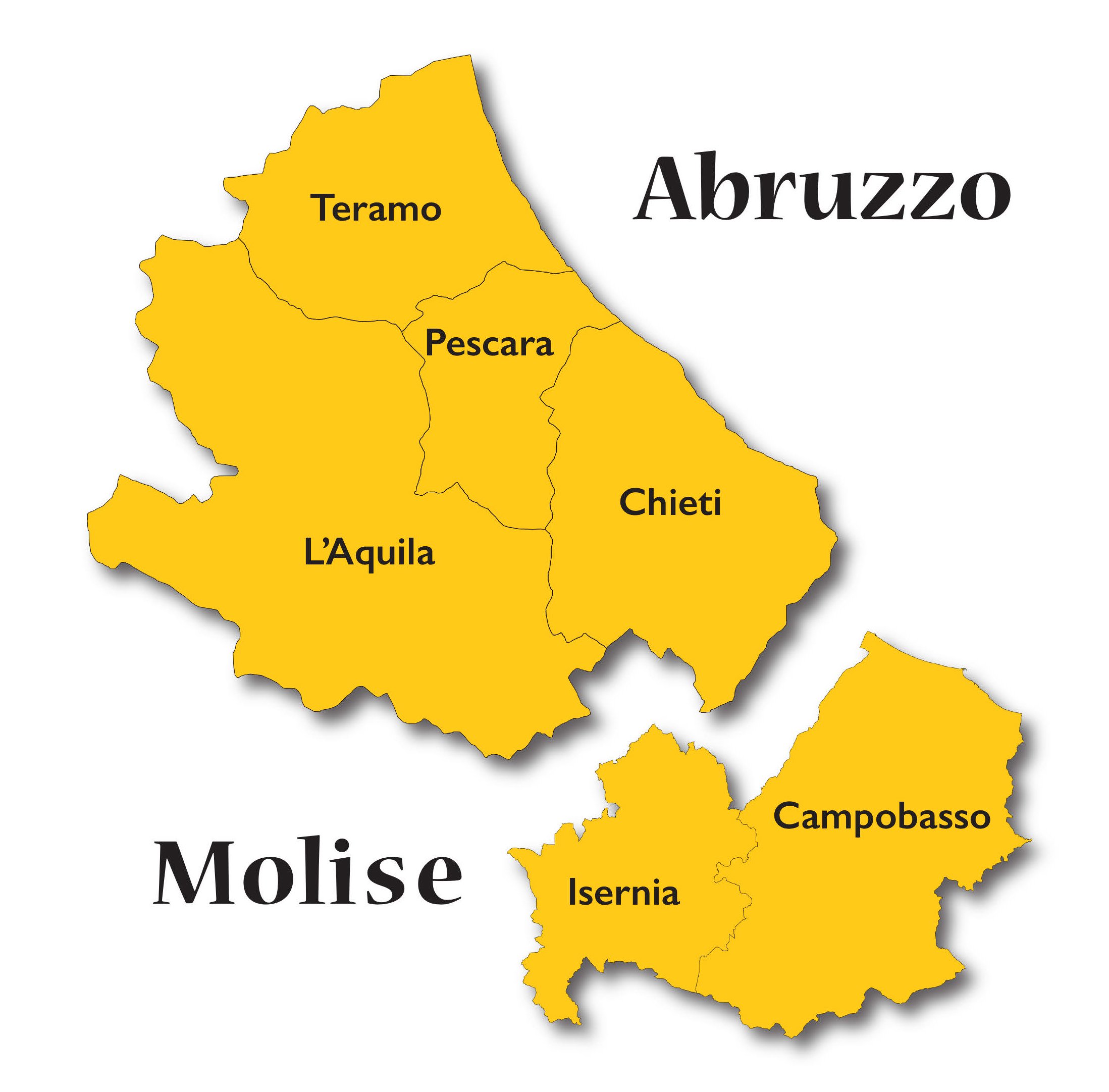
AMHS members have ancestral roots in Abruzzo, Molise, and sometimes from both regions! If you or your family’s origins are tied to a specific municipality, it is easy to find what region you identify with just by referring to a modern map. But it was not always so.
When I first visited Italy in 1976, I purchased a train ticket in Rome, wanting to go to a village in Abruzzo in the province of Campobasso. The man at the ticketing widow started chuckling: “Your grandfather must have given you this information. The village is now in the Molise region, province of Isernia.” Things changed.
The lands of Abruzzo and Molise encompass an area long associated with the ancient Samnite tribes—Samnium being their geographic homeland that existed over 2,000 years ago. These fiercely independent people faced the rise of Roman power and eventually succumbed to Romanization. They had a great influence on the Romans, including methods of warfare and social organization. One of the tribes, the Praetutii, lived in an area centered around modern Teramo called “Aprutium” in Latin, linguistically evolving into “Abruzzo” as the region is called today. Its borders have remained nearly the same over the following centuries.
In 1273, the king of Naples and Sicily divided Abruzzo into two territories, split along the Pescara River, the “Nearer Abruzzo” and “Further Abruzzo” earning the plural name of Abruzzi. “Further Abruzzo” was again divided into two parts in 1806. Today we see these areas corresponding to the provinces of Chieti (Nearer Abruzzo); Teramo and Pescara (Further Abruzzo I) and L’Aquila (Further Abruzzo II).
Molise has its own story. Like Abruzzo, Samnite tribes were there and the Romans followed. A big change came when a Germanic group, the Lombards, invaded. Between 568 and 774, they controlled most of the Italian Peninsula. Their leaders divided up the lands into 36 duchies with two encompassing present-day Abruzzo (Duchy of Spoleto) and Molise (Duchy of Benevento). Then, from the northwestern area of modern-day France, the Normans entered the Italian Peninsula and conquered the south. Their rule from 999 to 1194 included Sicily and was known as the Kingdom of Sicily.
Norman leaders divided up the lands among themselves. One of the nobles, Rudolf de Moulins, arrived in Bojano in 1045 and became its Count. His family name became Italianized to “Molise”. A century later, the County of Bojano was renamed the County of Molise. Most scholars feel this is the basis on which the region became known. A few think the name Molise is derived from the word “mulino” (mill) because so many mills were used in the region for grinding grain into flour.
When southern Italy came under Spanish rule from 1503 to 1860, they made a jurisdiction called the County of Molise, which was slightly smaller than the present-day region. Spanish rule was overthrown by Giuseppe Garibaldi and south Italy joined the northern Kingdom of Sardinia as a step toward unification. The new Kingdom of Italy was proclaimed in 1861. Following World War II, the Italian Republic was formed as the Italy we know today.
Between 1927 and 1963 Abruzzi and Molise were considered as one region. Many in Molise felt it best to face the future on their own and the region was split in 1963. In 1970 Molise officially became one of Italy’s twenty regions.
Is Abruzzo/Molise one region or two? There is now a push to re-marry the two regions. We wait to see the outcome. What we know for sure is that these two areas have much in common historically and culturally. If you are an Abruzzese or Molisan, you can find your geographic origin on modern maps.
Some of the oldest continuous civic centers in Italy are found in cities like Chieti, Atri, Teramo, Sulmona, Isernia, Larino and Venafro. Famed for their ancient artifacts, these towns were first settled by Samnite tribes who defeated Roman forces. Medieval and Renaissance hill towns located in spectacular landscapes preserve rural lifeways such as pastoralism, shepherd routes, and a unique musical and gastronomic heritage. Such rich layers of history give Abruzzo and Molise their special character that continue to influence all who are tied by bloodline to these culturally rich regions.
______
Michael DeMarco, M.A., has written three books dealing with Abruzzo and Molise: a biographical novella (To Give to the Light), an illustrated childrens’ book (Pentro: Horses of the Spoon-Shaped Valley) and a scholarly work (Mundunur), with separate editions in English and Italian.
Winter 2026